

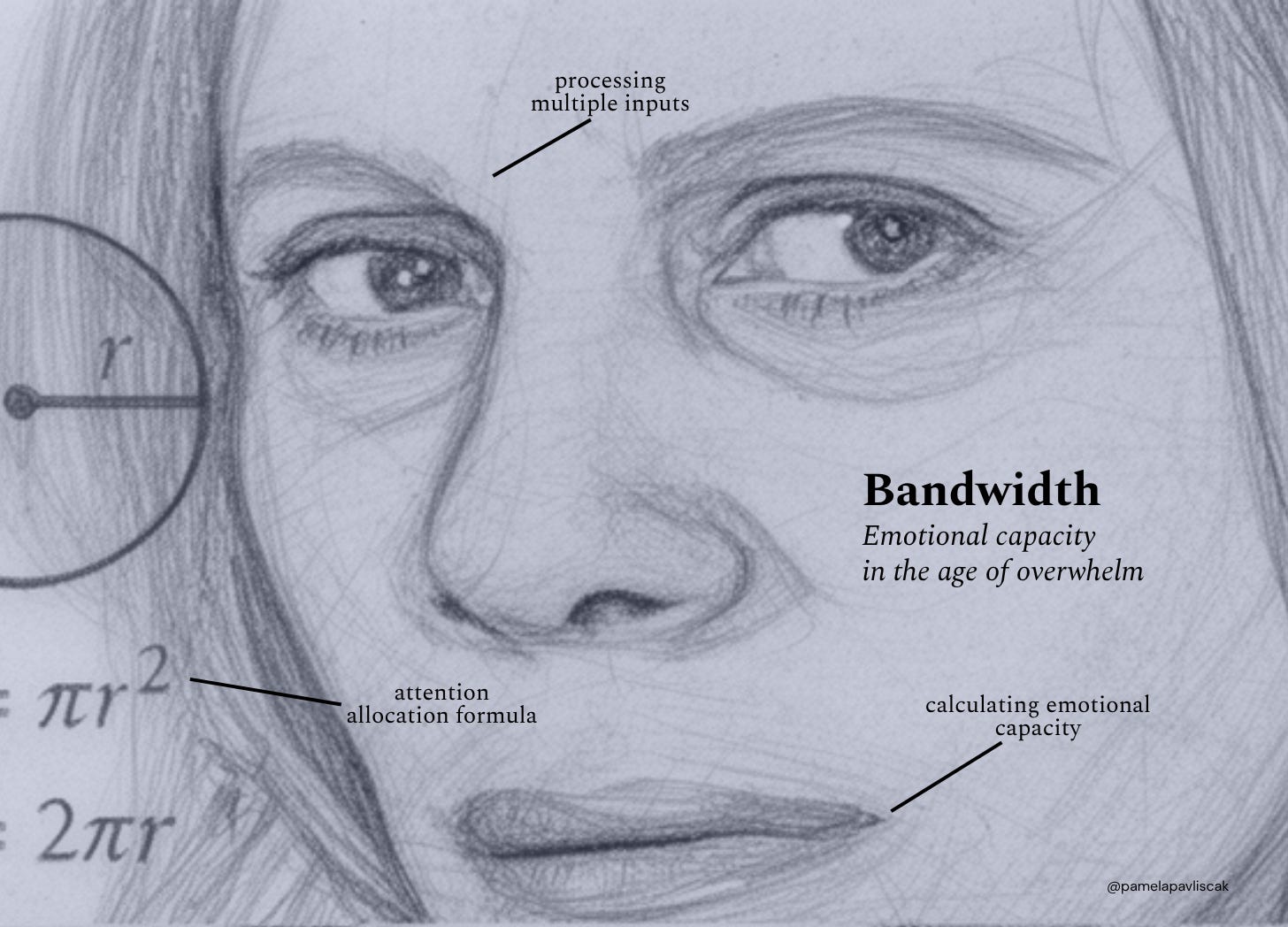
Bandwidth > Emotional Capacity in the Age of Overwhelm
When humans start describing feelings like data transfer

A Friday feeling for the emotionally online, cataloging the moods, memes, and mediated sensations of digital life.

◈ DEFINITION
Bandwidth is the increasingly common way people describe their emotional or cognitive capacity. Instead of saying “I’m overwhelmed,” we say we don’t have the bandwidth. Instead of needing rest, we need to recharge. When things go terribly wrong, we fantasize about a hard reset. Originally a telecommunications term describing how much information can move through a channel at once, bandwidth has migrated into everyday vocabulary.
Type: Machine metaphor
See also: Doomscrolling, notification fatigue, surge capacity
❖ A BRIEF HISTORY
In engineering, bandwidth refers to the maximum rate at which data can be transmitted across a network. The metaphor began slipping into workplace language in the late 1990s and early 2000s, particularly in technology and knowledge work. Colleagues started asking whether someone had “the bandwidth” to take on a project. Over time, the phrase escaped the office and entered everyday speech. Journalists have noted that the everyday emotional meaning of bandwidth is now widespread enough to appear in standard dictionaries.
Today, it shows up in group chats, therapy sessions, parenting forums, and social media posts explaining why someone can’t take on another commitment. This linguistic shift reflects a broader cultural moment. As digital life accelerates the flow of messages, notifications, news, and responsibilities, emotional capacity begins to feel less like a vague internal state and more like a measurable system resource.
The language of machines offers a tidy way to explain a messy human experience. Too much data, not enough (emotional) processing power.
◉ EXPRESSION
When people talk about bandwidth, they often mean time, attention, and emotional energy all at once. Bandwidth shows up most clearly when people try to set boundaries, as in “I wish I could help, but I don’t have the bandwidth right now.” The phrase carries a curious tone of technical neutrality. It avoids the vulnerability of saying “I’m exhausted” or “I’m struggling.” Instead, it frames emotional limits as a system constraint. In this way, bandwidth becomes a polite social shorthand for burnout, or simply needing space.
Of course, the phrase also developed a reputation as corporate jargon. In workplace Slack threads and meeting invites, it often appears in sentences like, “Let’s circle back when everyone has the bandwidth.”
✺ EXPERIENCE
When people say they lack bandwidth, they are often describing the feeling of too many inputs arriving at the same time. Having a bandwidth issue feels like:
Opening your laptop and realizing there are already twelve tabs competing for your attention before the day has properly begun.
Someone asking you a thoughtful question while your phone vibrates insistently on the table.
Reading a long message that begins with “Quick question…” and realizing that it will not, in fact, be quick.
Watching a Slack notification appear just as you finish responding to the previous Slack notification.
Attempting to process global news, work email, and family logistics within the same fifteen minutes.
Human attention has always had limits. Cognitive psychologists have long described attention as a finite resource, and research on multitasking consistently shows that the brain doesn’t actually process multiple complex streams of information at once. It simply switches between them very quickly, often with a measurable cost.
➤ PRO TIP
When you catch yourself saying “I don’t have the bandwidth,” try treating the situation exactly like a system under load.
Close a few tabs. Not just the literal browser ones (though those too). Unfinished loops do occupy mental capacity. Sending a quick reply, making a small decision, or deleting a draft you’re never going to finish can all free up bandwidth.
Reduce incoming traffic. Every notification competes for the same processing channel. Temporarily silencing a few apps, muting a busy group chat, or stepping away from the news cycle can slow the flow enough for the system to stabilize.
Single-thread for a while. Computers with limited bandwidth perform better when they focus on one task at a time. Humans do too. Try giving one conversation, one project, or even one mundane task your full attention for a few minutes.
Run something analog. Walk around the block. Physical movement helps reset attention in ways a screen rarely can.
Bandwidth rarely returns all at once. But small adjustments can reduce the traffic enough for the signal to come through again.
▣ BIG PICTURE
As digital systems become more pervasive, the metaphors we use to describe ourselves begin to resemble the machines we interact with every day. We talk about processing information, managing inputs, optimizing workflows, and recharging batteries. Emotional limits become system constraints.
The metaphor isn’t entirely wrong. Human attention and emotional energy are finite resources. But the internet operates at near-infinite speed and people do not.
***
I think about bandwidth a lot.
As a researcher, I have spent years documenting how people actually use the internet. Through diaries, interviews, and observation, I’ve watched how quickly digital life fills every available channel.
The modern internet asks us to process work, news, friendships, and family logistics through the same glowing rectangle. No wonder we talk about emotional capacity like a network channel.
Some days the signal is strong. Other days the system is clearly at capacity.
xoxo
Pamela
If this post buffered successfully:
♡ Tap the heart to boost the signal
✼ Leave a comment or a “quick question”
↗ Share it with someone who increases your bandwidth
Subscribe to Feeling Digital