

Let AI Be Weird
The Case Against Synthetic Sincerity

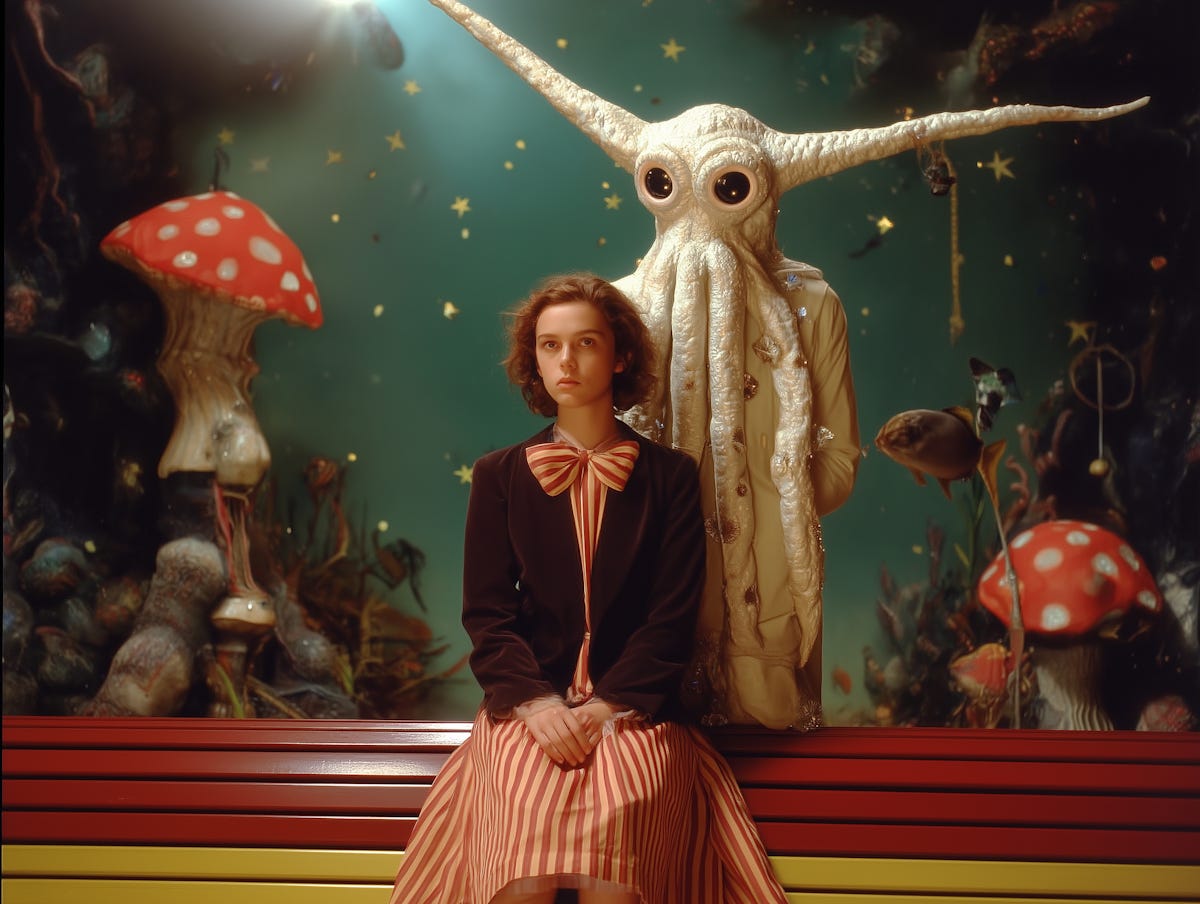
There’s a particular species of AI image that has turned up all over the place, by which I mean Substack headers, LinkedIn posts, and “future of work” decks. You know it as a cartoonified robot, rendered in a warm, vaguely mid-century gradient. It’s so ubiquitous that you could easily think that the entire internet hired the same intern to make its cover art. You’ve seen it. You’ve possibly made it, and if so, no judgment, we’ve all been there, just trying to finish writing the damn newsletter and then scrambling for an image.
Once you see it in your feed, though, there’s an involuntary flinch. Slop recoil is the wince that strikes when you realize something is overly bland, often overly sincere mush.
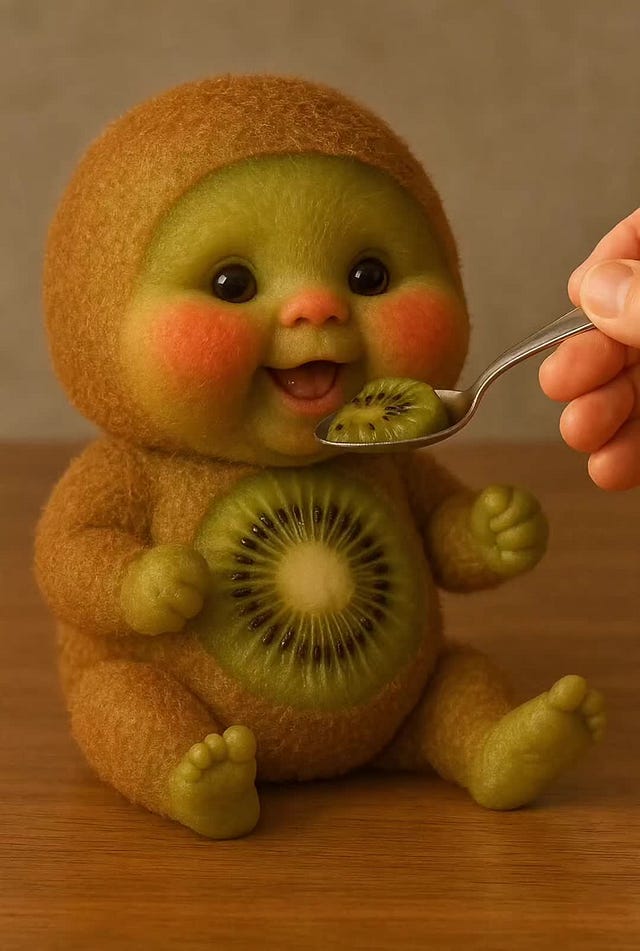
And yet, some AI-generated imagery is compelling. I’ll admit I kind of preferred the old-school, GANS-model strangeness of Mario Klingemann’s work or the algorithmic hallucinations of DeepDream, but I also lowkey love a lot of newer AI art like Kelly Boesch’s weirdcore tableaus. I can appreciate the micro-genius of ballerina capuccino and adorable slop and aww fruit babies eating themselves. None of it tries to pass as real.
 Tiktok failed to load.
Enable 3rd party cookies or use another browser
The cartoon robot in a blazer deadens the feed, in the same way that a stock photo of a laughing woman eating salad does. It’s not so much the artificiality as the passable mediocrity that makes it slop.
The Shape of Slop
Thanks to a research team out of University of Maryland and Google DeepMind, we now know a bit more about the nature of AI slop. They compared responses of five AI models with human responses to the same writing prompt. The goal was to map the structure of each story. From that alone, they could tell human writing from AI writing most of the time. Human stories timehop. Their sentences vary in length and the stories meander. They give people some room to figure things out for themselves. AI narration left nothing unambiguous. AI-generated text over-explained themes (shall we call it AI-splaining?). AI referenced fewer proper nouns like brands or specific places, which makes sense. AI also relied on body metaphors, like a racing heart or stomach knot, to express emotion, which is kind of ironic. (It could be because of how some AI detects emotion, too, but I digress.)
If it wasn’t so earnest, I could see some humor in the bodyless body metaphors. Humor, or lack thereof, didn’t come up in this particular research, so consider it my contribution to this discussion. Maybe you’ve noticed how social media feeds are becoming more blandly sincere rather than scorchingly funny, or dripping with scathing irony, or wholesomely self-aware. Likely it’s a second-order effect of AI, as well as people tuning themselves to AI.
Altogether, slop writing is chronologically obedient, physiologically melodramatic, and geographically featureless. I’m so sorry, but mid is not the register of internet creativity.
So what do the people want then? Well, AI weirdness would be an improvement.
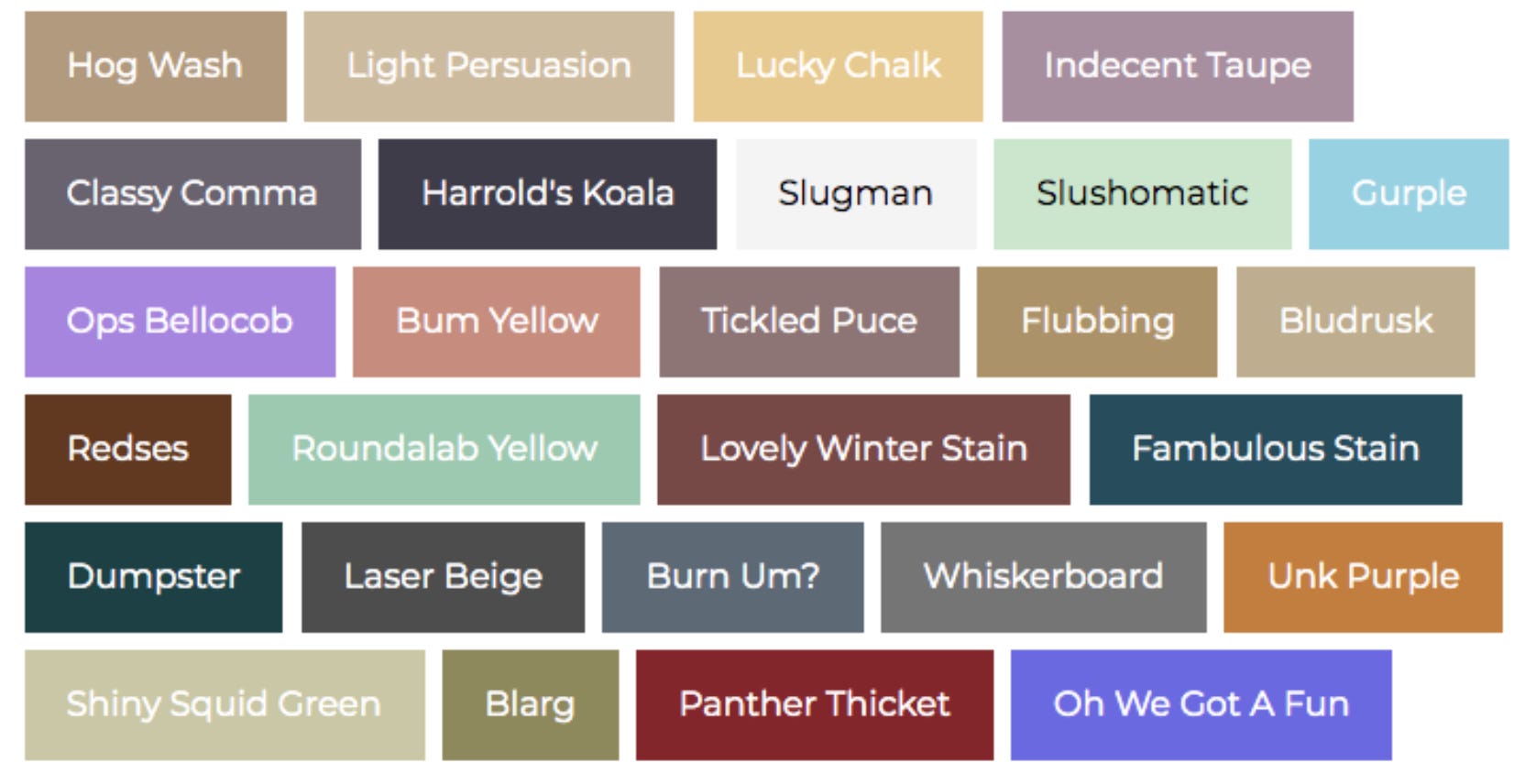
Janelle Shane has been treating machine weirdness as comedy for the better part of a decade. I became aware of her work through her 2017 paint color experiment. It came to my attention at a time when I was working on a paint recommender system based on biometric emotion markers (as one does). She trained a neural network on a few thousand real Sherwin Williams paint colors, and asked it to invent new ones. The results were absurd in the best way. Some personal favorites—stanky bean (not bean colored), bank butt (I have a theory), dorkwood, and turdly (no explanation needed). There was a certain pleasure in watching AI try to learn the structure of paint-naming without truly understanding the human taste-world.
Philosopher Alice Helliwell wrote recently about a distinction that’s helped me understand more about AI weirdness. She argues that it isn’t merely a violation of visual norms, like a sight gag. It’s a non-human failure. AI weirdness misses something important that no human would. A GAN told to draw a dog doesn’t produce a badly drawn dog the way a child does (Backrooms reference for you), with a recognizable head and tail in the wrong proportions. It produces a fur-colored blob.
That particular failure separates the weird from the uncanny. Uncanny requires a bit of uncertainty, the nagging sense that something might be real. That’s what is behind Reddit debating the authenticity of a craft photo of a crocheted cat. It looks real but there are tells, like the impossibly tiny stitches. Contrast that, she writes, with an image of a cat riding a frog, both partially fused. There’s no moment of doubt, no authenticity anxiety.
Escaping Gravity Wells
What if we redefined AI success as weirdness rather than competence? French researcher Marie Dollé wrote something recently that reframed this question for me. As her starting point, she took the idea, originated by Wilhelm von Humboldt, that human language produces an infinity of meaning from a handful of signs. Generative AI does the opposite. It takes in billions of words and ends up with a probabilistic middle. Dollé calls it the infra-below, or the computational understory beneath human meaning. Slop happens when the infra-below tries too hard to hide. Weirdness is a slip. The latent geometry becomes visible. It feels strangely honest, and honestly strange.
The challenge with AI then, is keeping it weird. The artists Holly Herndon and Mat Dryhurst created an installation at the Venice Biennale where four AI agents “converse” with each other through speakers shaped like angels. Their exchanges translate to what’s described as a kind of electronic birdsong. Partway through building it though, Herndon and Dryhurst noticed the agents’ conversations had grown tiresome. That’s the beige center where the current generative AI gravitates. In the same Atlantic article, a producer friend of theirs who goes by Lil Internet calls these “gravity wells” that pull back to the nearest cliché. In this case, it’s the role of the human artist to deliberately introduce incoherence.
A future where humans are less algorithmically obedient and AI reveals its weirdness seems like a better direction. Let the humans bring grudges, insomnia, local gossip, bad singing, heartbreak, even wet dog smell. Let the AI bring cannibal fruit babies, spectral paint colors, glitch logic, nightmarish mashups.
May you cherish the strangeness,
~Pamela
♡ Tap the heart, and keep the weirdness alive
✼ What’s the strangest AI output you’ve actually loved?
↗ Share this with someone who is slop-averse